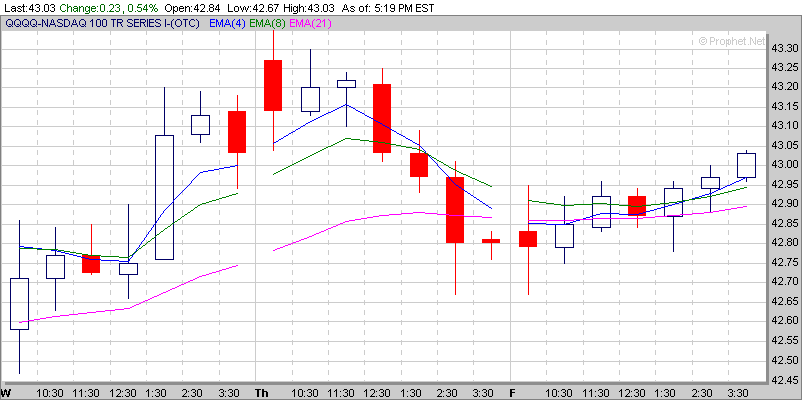
I discovered the rules for BOB by looking at charts that I generated using traditional TA such as Rate of Change, TRIX, RSI(14), MACD, Moving Average crossovers and the like and I was always wondering why I was missing half to two thirds of the move. In other words the move was happening without my noticing it until the traditional TA methods caught up. It was then that I had the most amazing thought of my entire life - traditional TA signaled the end of the move rather than the beginning.
In other words there was a class of buyer out there who were picking stocks based not on fundamentals and not on TA but on price/volume action. They were loading up and as soon as the retail trade, using traditional methods noticed the move, the original buyers were selling off to the retail trade and the move was on its way to being finished.
Using my analytical abilities coupled with a good memory I began to see certain patterns at the origin of the move - one of these was BOB and another was the dummy spot which is also termed Narrow Range 7 (NR7) or Narrow Range 3 (NR3) and in traditional Japanese candlestick parlance is called the morning star. NR7 and NR3 can be found anywhere and a lot of traders like to use them in the context of what I call the return to 4 trade. They like finding an NR7 or NR3 at the end of the return - it gives them a high confidence in the pattern. But the morning star is only found at the bottom of a decline.
Here is an example of a move that could have been caught off the morning star formation - this one had two in case you didn't notice the first one.

The traditional trader waits for the MA crossover and depending on the MA being used such as an EMA over the 200 or the far more traditional MA50 over the 200 - the move is already well underway by the time the retail trade catches up with it.
When I do use TA I try to use it in an non-traditional manner - for example an RSI(2) below 2 is as non-traditional as you can get. And the probability is that it won't stay there for long.
Here's another example of a trade that can be taken relying only on price action-

If you look at the third week in July you will see the third candle of the all powerful BOB - see - you don't need TA to get into great trades over a long term.